
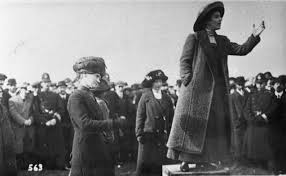
Rose Emma Lamartine Yates (1875–1954) was a prominent English social campaigner, suffragette, and politician who dedicated her life to fighting for women’s rights and social welfare. Born in Lambeth to naturalised British citizens of French origin, she received a high-level education at Royal Holloway College and passed the Oxford final honours examination in 1899. In 1900, she married Thomas Lamartine Yates, a solicitor who became a steadfast supporter of her activism.
Suffrage Activism and the WSPU
Yates joined the Wimbledon branch of the Women’s Social and Political Union (WSPU) in 1908. Her commitment was absolute; she was first arrested in February 1909 during a Westminster protest and served a month in prison, despite public criticism for “abandoning” her eight-month-old son. Her husband defended her at trial and later provided legal counsel to other activists, including the family of Emily Wilding Davison, after her death at the 1913 Derby.
By 1910, Yates was appointed the honorary secretary of the Wimbledon WSPU, transforming it into one of the organisation’s most flourishing branches. She travelled widely as a lecturer, participated in the 1911 census boycott, and turned her home, Dorset Hall, into a refuge for activists recuperating from imprisonment. She remained close to the movement’s most radical elements and was present at Emily Wilding Davison’s bedside when she died in 1913 and leading the guard of honour at her funeral.
War and Political Split
The outbreak of the First World War caused a permanent rift between Yates and WSPU leader Emmeline Pankhurst. While the national leadership suspended suffrage campaigning to support the war effort, Yates insisted on continuing the fight for the vote. In 1915, she helped form a new body called the Suffragettes of the WSPU (SWSPU). Locally, she directed her energy towards social relief, converting WSPU premises into soup kitchens to support those in distress.
Later Career and Legacy
Following the granting of limited female suffrage in 1918, Yates was adopted as a Labour candidate for Wimbledon but withdrew before polling. In 1919, she was elected to the London County Council as its only independent member. During her three-year term, she campaigned tirelessly for equal pay, nursery education, and better public housing.
In her later years, Yates focused on preserving the movement’s history. In 1939, she opened the Women’s Record House in London. Though the building was later bombed during the Second World War, many saved records were incorporated into the Suffragette Fellowship collection at the Museum of London. Rose Lamartine Yates died in 1954 at the age of 79.
